
If you’re shopping for an ozone generator, you’ll quickly notice a huge price range. Some machines cost around $30 shipped; others cost several times that. Most of the difference comes down to one part: the component that actually makes the ozone. Nearly every machine uses either a quartz tube or a ceramic plate. This guide explains the quartz tube vs ceramic plate ozone generator question in plain English: how each works, what happens as they age, why tiny particles matter, and how to tell which one you’re buying.
A quick safety note first: ozone generators of either type are for ozone shock treatments of unoccupied spaces only. Nobody (people or pets) should be inside while the machine runs, and the space should be aired out for at least an hour before anyone goes back in. The U.S. EPA states that intentional ozone generators should not be used in occupied spaces (EPA).
How Ozone Generators Work (the Short Version)
Most ozone generators use corona discharge. A transformer creates a high voltage between two electrodes separated by an insulating barrier (called a dielectric). The electric field splits oxygen molecules (O2) in the air, and the loose oxygen atoms join other oxygen molecules to form ozone (O3). That’s why we like to say ozone generators don’t really “create” ozone; they convert the oxygen in the air into ozone. The difference between machines is mostly in what the electrodes and the barrier are made of, and how well they handle heat.
How a quartz tube ozone generator works
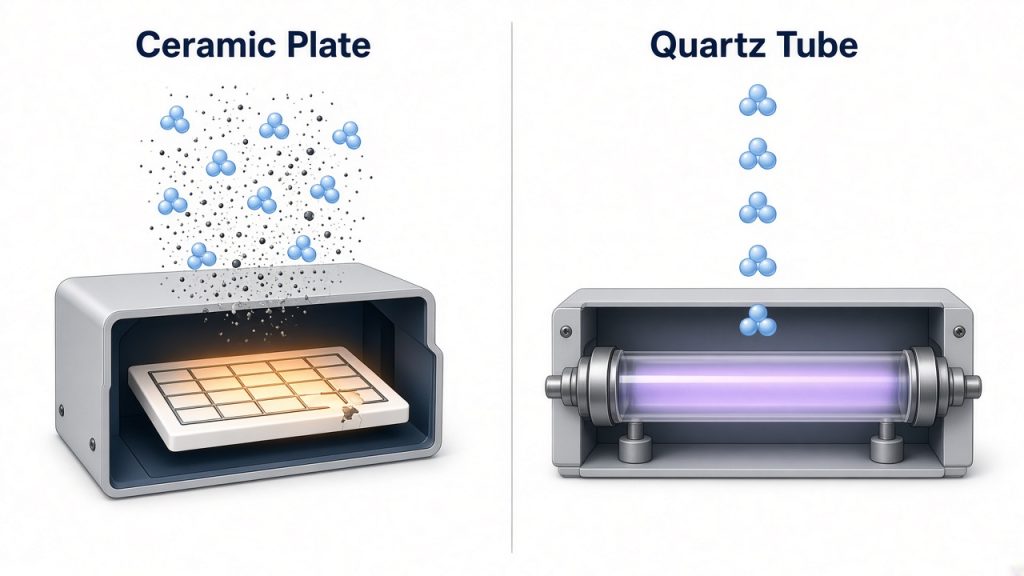
In a quartz tube element, the insulating barrier is a tube of quartz glass. In Forever Ozone machines, stainless steel mesh sits on the inside and outside of the quartz tube, and the corona forms across the glass. This basic design, sometimes called a dielectric barrier discharge tube, has been used to make ozone for well over a century. Quartz is very heat-resistant and doesn’t react with ozone, so the tube itself holds up well. We also find quartz tube elements handle humidity much better than plates (see our ozone sizing guide for how humidity affects output).
How a ceramic plate ozone generator works
A ceramic plate element uses a flat ceramic plate as the barrier, with very thin nano metal lines (often printed or screen-printed in a pattern) on its surface as the electrode. Plates are cheap and compact, which is why they’re found in most low-cost ceramic plate units. The trade-off is that those thin metal lines sit right where the corona discharge happens, and the plates get hot quickly.
What Happens as Ceramic Plates Wear Out
Corona discharge is hard on metal. Researchers have studied this for decades, and the findings are consistent:
- Corona discharge erodes metal electrodes over time through local heating, tiny “micro-explosions” on the surface, and oxidation (Scientific Reports, 2021).
- Electrode erosion produces airborne particles. Studies of corona discharge emitters used in clean rooms found that metal emitters shed small particles as their surfaces oxidize and erode (Journal of Aerosol Research), and experiments with copper electrodes found agglomerates of roughly 10-nanometer particles forming from eroded metal.
- Even inside industrial ozone generators, metal electrodes break down: one study found oxide powder of iron, chromium, and nickel forming on stainless steel electrodes, with surface temperatures estimated above 1,000°F, and ozone output dropping to nearly zero as the electrodes deteriorated (Plasma Research Express, 2021).
Now apply that to a low-cost ceramic plate with paper-thin printed metal lines. In our experience at Forever Ozone, and in machines our customers have sent us, the plates run hot within minutes, the metal lines visibly darken and wear, and output fades as the lines wear away until the plate stops producing ozone. Where does that worn-away metal go? It has to go somewhere, and in a machine with a fan, the likely answer is into the air. We’re not aware of a published study that has measured particle emissions from these specific low-cost plates, so treat that last point as our professional opinion, not a lab result. But it’s consistent with the research above, and it’s one of the main reasons we only use quartz tube technology.
Why Breathing Metal Nanoparticles Matters
Particles this small (nanoparticles are less than 100 nanometers, about a thousandth the width of a human hair) behave differently than ordinary dust. They can travel deep into the lungs, and research shows several kinds of metal nanoparticles cause inflammation there:
- In a controlled study, healthy volunteers who breathed zinc oxide nanoparticles for a few hours developed airway inflammation and symptoms such as throat irritation and cough (PubMed, 2019). The effects went away afterward, but they showed up at the lowest dose tested.
- Animal studies found nickel oxide, copper oxide, zinc oxide, and cerium oxide nanoparticles each caused lung inflammation, some of it lasting weeks and including fibrosis (Environmental Health Perspectives, 2010).
- A review of iron oxide nanoparticles linked lung exposure in lab studies to inflammation, fibrosis, and DNA damage, while noting the human risk isn’t fully understood yet (NIH/PMC, 2017).
Separately, regulators warn that ozone itself reacts with chemicals in indoor air to form formaldehyde and ultrafine particles (California Air Resources Board). That’s true for any ozone generator, and it’s exactly why proper shock treatment practice matters: run the machine only in an empty space, then flush the space with fresh air before anyone returns. What you can control is whether the machine adds extra metal particles on top of that. With quartz tubes, the part doing the work is glass, not a paper-thin printed metal line.
Lifespan and Cost Over Time
A cheap plate machine looks like a bargain until you count replacements. Here’s how the two usually compare, based on how they’re built and on our experience:
| Low-cost ceramic plate unit | Forever Ozone quartz tube unit | |
|---|---|---|
| Ozone element | Thin printed metal lines on ceramic | Quartz glass tube with stainless steel mesh |
| Heat | Plates run hot quickly | Runs cooler |
| Humidity | Output drops sharply in humid air | Humidity-resistant |
| Output over time | Fades as the metal lines wear | Steady |
| Replacement | Usually replace the whole machine | Lifetime warranty; replacement tubes and transformers available |
Our machines come with a lifetime warranty, and we sell replacement quartz tubes and transformers so a unit can keep running for years. As my mama always told me: cheap things are expensive in the long run.
How to Tell Which Type You’re Buying
- Look at the photos. A ceramic plate is a flat rectangle, often white with a printed pattern (honeycomb or grid lines). A quartz tube is a round glass tube wrapped in mesh.
- Read the listing for the words. “Ceramic plate,” “ozone plate,” or a list of plate counts usually means plates. Sellers using quartz tubes generally say so.
- Be skeptical of huge output numbers on tiny, cheap machines. Ozone output depends on the size and number of elements; one or two small plates can’t make tens of grams per hour. (We wrote about inflated ozone output claims.)
- Ask about replacement parts and warranty. If the only fix is buying a new machine, you’re buying a consumable.
- Ask for help. A seller who’ll explain how to run a safe ozone shock treatment is worth a lot.
Recommended Quartz Tube Ozone Generators
- Forever Ozone Large Room Ozone Generator (10g quartz tube): our bestselling shock treatment unit.
- 15g Five Quartz Tube Bare Bones Ozone Generator
- Commercial “Window Sill” 30,000 MGH Quartz Tube Ozone Generator
- Commercial 60,000 MGH Quartz Tube Ozone Generator
Not sure what size you need? Start with our ozone sizing guide, or read why we moved away from plates in Ceramic Ozone Plates Discontinued for Health Concerns.
Quartz Tube vs Ceramic Plate FAQ
What is the difference between a quartz tube and a ceramic plate ozone generator?
Both use corona discharge to turn oxygen into ozone. A quartz tube uses a quartz glass tube as the barrier, with stainless steel mesh electrodes. A ceramic plate uses a flat ceramic plate with thin printed metal lines as the electrode. Quartz handles heat and humidity better, and in our experience lasts much longer.
Do ceramic plate ozone generators release metal particles?
Research shows corona discharge erodes metal electrodes and produces fine particles. We’re not aware of a published study that has measured emissions from low-cost ceramic plates specifically, but in our experience their thin metal lines visibly wear away with use, and that material has to go somewhere.
Why does my ozone generator stop producing ozone?
On plate machines, the printed metal lines degrade with heat until output fades. Humidity also cuts plate output sharply. Quartz tube elements hold up better, and Forever Ozone sells replacement tubes and transformers.
Are quartz tube ozone generators safe to use around people?
No ozone generator should be used in occupied spaces. Run ozone shock treatments only in empty rooms with no people or pets, then ventilate for at least one hour before re-entering.
Which is better value over time?
A low-cost plate unit may need replacing once its plate wears out. A quartz tube unit costs more up front, but with a lifetime warranty and replaceable parts, it can keep running for years.
Ready to stop replacing cheap machines? Browse our quartz tube ozone generators or call us at (888) 989-8764 for free advice on choosing the right size for your shock treatment.